

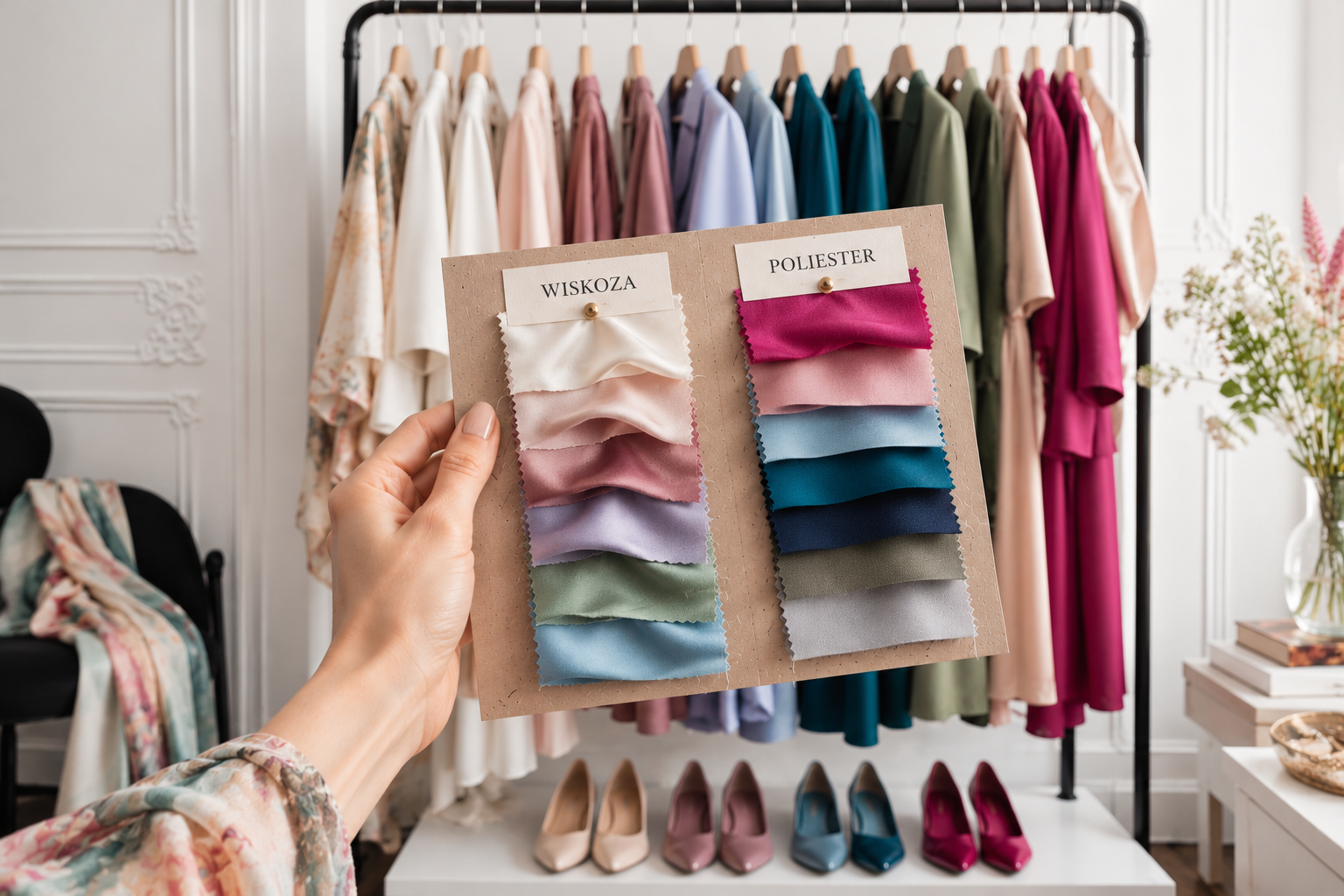
Viscose sounds natural. But is it really?
Viscose! What a pleasant name. Soft, delicate, fluid, often reminiscent of silk. Many people see it as a nobler, more natural material, and therefore also more eco-friendly than polyester.
In conversations with my customers, I notice myself that viscose has a far better reputation than synthetics. Its presence on a garment’s label is often taken as a sign of quality, or even luxury.
There is, however, one detail that is rarely mentioned.
Viscose is not a natural fibre. It is a man-made fibre of natural origin – more precisely, a cellulosic one.
That’s an important difference. The raw material for viscose really is natural cellulose, most often obtained from wood. But turning it into a fibre requires a multi-stage industrial process involving chemicals.
In the classification of textile fibres, viscose therefore belongs to the group of man-made fibres, alongside modal and lyocell. Polyester, on the other hand, is a synthetic fibre, usually made from petroleum-based raw materials.
Does this mean viscose is a bad material? Absolutely not. It can be very pleasant to wear, drape beautifully and work wonderfully in clothing. A high-quality viscose fabric can be an excellent premium material.
But we shouldn’t confuse a fibre’s practical qualities with an eco-friendly way of producing it.
And this is where a much less pleasant story begins.
Fast fashion – when clothes become disposable
Not so long ago, people bought clothes with several seasons in mind, and often many years of wear. Today, new collections appear almost non-stop. Trends change in a flash, prices encourage more and more shopping, and things that only recently arrived in stores quickly make way for the next ones.
This is how fast fashion works – a business model based on rapid production, high product turnover and stimulating consumption.
One of the foundations of this system is cheap, readily available textile fibres.
Polyester holds a special place among them, having dominated global fibre production for years. Viscose is also widely used in the clothing industry, both in inexpensive collections and in far pricier fashion.
Both materials have their practical advantages. The problem begins when they are produced in huge quantities, used to make clothes with a short lifespan, and then replaced with new ones.
Polyester – crude oil hidden in our clothes
Polyester is a synthetic fibre, most often made from raw materials derived from crude oil and natural gas.
Its popularity in the clothing industry is no accident. It is relatively cheap, durable, crease-resistant, quick-drying and offers enormous technological possibilities. It can be used to produce thin, airy fabrics as well as knits, fleece or technical materials.
But behind these qualities lies an environmental cost.
Polyester production relies largely on non-renewable fossil resources. It requires energy and involves greenhouse gas emissions. What’s more, like other conventional plastics, this fibre does not biodegrade easily in the natural environment.
Microplastics are a separate problem.
During the production, wear and washing of synthetic textiles, microscopic fibres can break off. Some of them end up in water, soil and air, and then travel through the environment.
Imagine that during an ordinary wash of your favourite polyester blouse, tiny fibres are released that you can’t see with the naked eye. Some will be caught at the wastewater treatment plant, but not all of them. Some may travel further, into rivers and seas.
According to the European Environment Agency, between 200,000 and 500,000 tonnes of microplastics from synthetic textiles may enter the world’s marine environment every year.
Importantly, the problem doesn’t end when the polyester blouse is thrown away. The material can remain in the environment for a long time, gradually breaking down into ever smaller fragments.
Viscose – plant roots and industrial production
Let’s go back to viscose, because its story is a little more twisted.
Unlike polyester, viscose is made from cellulose, a natural polymer found in plants. And that’s exactly why it may seem like a more environmentally friendly material.
However, to turn wood pulp into a delicate fibre suitable for spinning, it has to be chemically processed.
The traditional viscose method uses, among other things, carbon disulphide – a toxic substance whose uncontrolled emissions can pose a threat to workers, local residents and the environment.
Poorly managed production can also lead to water pollution from industrial wastewater and emissions of harmful sulphur compounds into the atmosphere.
Then there’s the question of where the cellulose comes from. If the wood is sourced unsustainably, fibre production can contribute to forest degradation and the loss of valuable natural habitats.
Not all viscose is made under the same conditions, though. There are technologies that reduce emissions and allow chemicals to be recovered, as well as systems for more responsible sourcing of raw materials.
That’s why the word “viscose” on a label alone doesn’t tell us how large an environmental footprint its production has left behind.
And what about biodegradability?
Here viscose has an important advantage over conventional polyester.
Because viscose is a man-made fibre of cellulosic origin, it can biodegrade much more easily than polyester.
Cellulose is a substance that the right microorganisms can break down. Research shows that under certain conditions, viscose fibres biodegrade much faster than conventional polyester fibres.
That doesn’t mean, however, that every viscose dress will break down in nature without a problem. A lot depends on environmental conditions, the dyes and finishes used, and any blends with other fibres.
Biodegradability is therefore an advantage, but it doesn’t cancel out the environmental costs of production.
139 million tonnes of fibres. How can we picture that?
In discussions about fashion and ecology, we often focus on individual materials and forget about a much bigger problem.
The scale of production.
According to a Textile Exchange report published in 2026, global fibre production reached a record level of around 139 million tonnes in 2025.
The number is so huge that it’s actually hard to imagine.
So let’s try another way.
139 million tonnes is 139 billion kilograms of fibres. If we divided that amount among everyone on Earth, each person would get around 17 kilograms.
Imagine a bag weighing 17 kilograms, filled with nothing but textile fibres. And a bag like that standing next to every person in the world. Including every baby.
And we’re talking about the production of just one year!
What’s more, compared with 2024, a whole 7 million tonnes were added. That annual increase alone equals the load of 700,000 lorries, if each carried 10 tonnes of fibres.
It’s worth remembering that the data cover all uses of fibres – not only clothing, but also home, technical and industrial textiles. So they aren’t a measure of the number of garments produced, but they show perfectly the scale of demand for raw materials.
In 2025, polyester alone accounted for around 59% of global fibre production.
And despite ever louder pledges about sustainable fashion, global production keeps growing.
Do we really need more clothes?
Online you can come across the claim that humanity has already produced so much clothing that it would last us several decades, or even the next few generations.
It’s a vivid comparison, but we don’t know exactly how many clothes are currently in wardrobes, warehouses, shops and second-hand circulation, what condition they are in, or how long they could still be used.
What we do know is that we are producing more and more fibres, while recycling used textiles into new clothing fibres still makes up a tiny share of global production.
According to Textile Exchange, in 2025 only around 0.76% of global fibre production came from textile-to-textile recycling.
And here comes a question that seems to me far more important than searching for the perfect material.
Do we really need so many new clothes, when so many things that have already been produced are still fit to wear?
And what about materials that already exist?
From an upcycling perspective, the moment a garment ends its first life is especially interesting.
A polyester dress, a viscose blouse or a forgotten piece of fabric doesn’t automatically lose its value just because someone stopped using it.
The material still has specific properties, structure, texture and possible uses. Provided, of course, that its condition allows it to be used safely.
Reusing textiles can reduce the demand for new raw materials and extend the time we use resources that are already in circulation.
This doesn’t mean upcycling will solve all the problems of the clothing industry. But it shows another possibility: instead of endlessly replacing things with new ones, we can take a closer look at what has already been produced.
And sometimes discover something in it that no one had noticed before.
Responsibility also starts in our own wardrobe
The scale of production and its impact on the environment are above all the result of decisions made in the industry – from sourcing raw materials, through production technologies, to how new collections are designed and brought to market.
But as consumers, we are also part of this system. Our shopping choices, the way we wear our clothes, how we care for them, repair them and pass them on all matter.
It’s not about burdening ourselves with guilt for every item bought at a chain store. After all, not everyone has access to more expensive, responsibly made clothing, and price isn’t always a guarantee of ethical production.
It’s more about awareness, which makes it easier to make our own decisions.
Maybe next time, before you buy another dress, you’ll take a look in your wardrobe? Maybe you’ll find something there that only needs a small change, a new combination or a little imagination?
Sharing knowledge matters too. Talking about fabric compositions, the origin of fibres or ways to reuse them can change our habits far more effectively than yet another eco slogan.
And we don’t have to give up the pleasure that fashion brings at all!
Quite the opposite.
Conscious fashion doesn’t have to mean sacrifice, a wardrobe full of beige clothes or constantly lecturing others. It can be fun, experimenting with colour and form, combining things that seemingly don’t go together, and discovering your own style.
And that’s the spirit in which I’d like to grow this blog.
We’ll take a close look at materials, uncover their secrets, test popular beliefs, learn upcycling techniques and look for new possibilities for things that already exist.
There will be room here for knowledge, ecology, craft, imagination and a touch of fashion madness.
Because you can love fashion, play with it, and at the same time make ever more conscious use of what the world offers us.
And if you feel like it, you can start right now. Look into your wardrobe and think about which of your things deserves another chapter.
Big hugs,
Yours, Peri XOXOXO
Sources and further reading
Textile Exchange – Materials Market Report 2026 – global fibre production, data for 2025.
European Environment Agency – Microplastics from textiles – microplastic emissions from synthetic textiles.
European Environment Agency – Textiles and the environment – the environmental consequences of textile production and consumption.
Changing Markets Foundation – Dirty Fashion – a report on pollution linked to viscose production.
Canopy – Hot Button Report 2025 – the origin of cellulose and threats to forests.
UOKiK (Polish Office of Competition and Consumer Protection) – Quality of textile products – classification of natural, man-made and synthetic fibres (in Polish).
BBC More or Less – Do we have enough clothes for the next six generations? – a fact-check of the popular claim about a surplus of clothes.


