

It all began with watching the world
Some day, take a look at a river seen from above.
See how its main channel splits into smaller branches, and how those branch out further, drawing an extraordinary network across the surface of the earth.
Now think of lightning cutting across the sky. Of tree branches, the veins of a leaf, or the blood vessels visible under the skin of your hand.
Do you see the resemblance?
It has fascinated me for years.
In all these phenomena I find a shared order. We recognise the characteristic pattern, yet we cannot predict exactly where the next branch will run.
Nature creates according to certain rules, and yet it never repeats its works in an identical form.
And this is the phenomenon I began to call Controlled Chance.
Over time I discovered that what I had been observing intuitively has its counterparts in science. Mathematics describes many branching structures through fractal geometry, and physics studies the processes that give rise to such forms.
I was also drawn to the theory developed by physicist Adrian Bejan, known as the Constructal Law, which concerns how flow structures take shape under given conditions.
I did not build my method on these theories. First I noticed the phenomenon in nature, and then I began to find it in my own work.
When, years later, I came across scientific descriptions of similar mechanisms, I smiled to myself.
Exactly! That’s what I create!
And what does all this have to do with knitting?
Quite a lot!
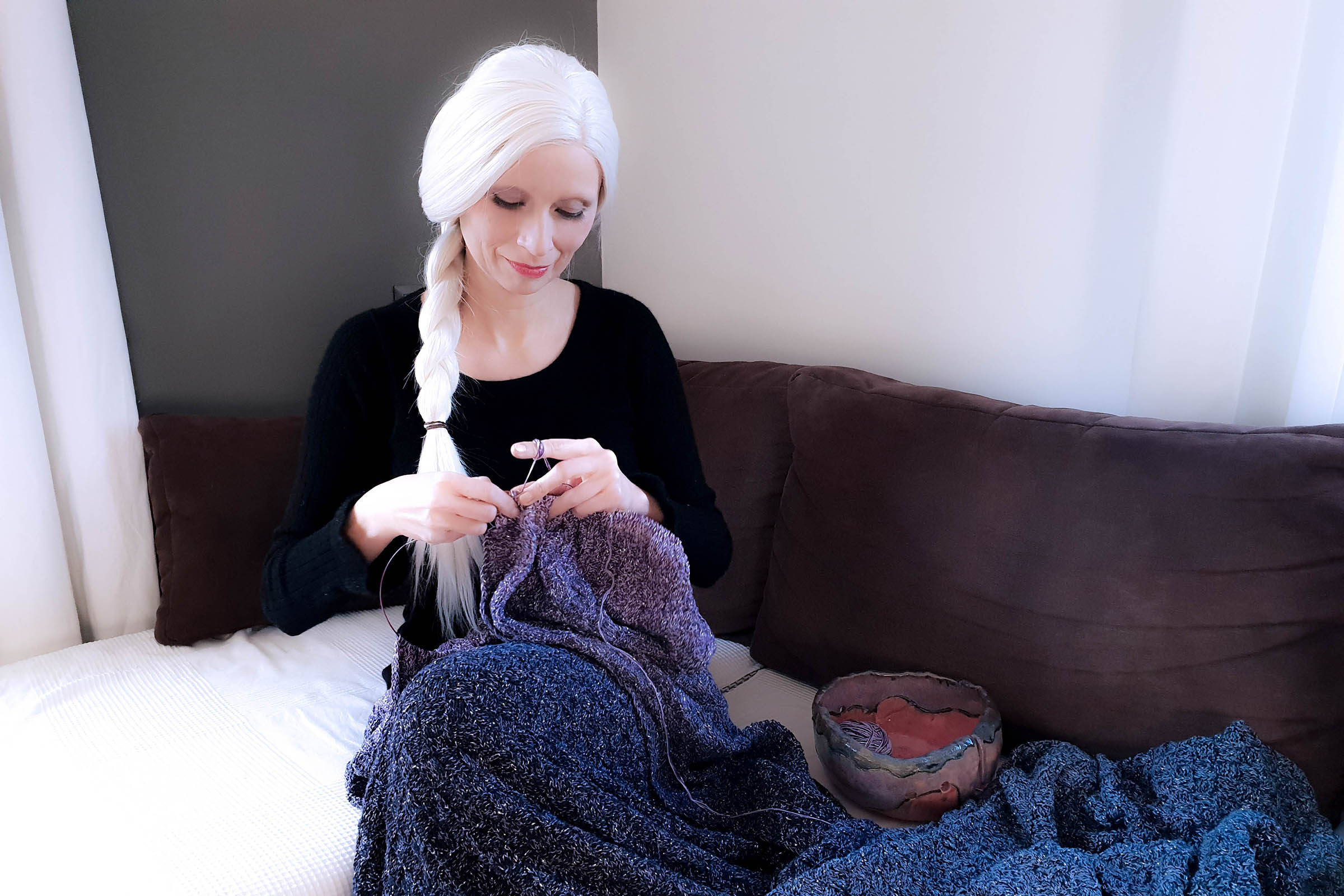
Over years of working with yarns, I developed my own way of creating knitwear.
When I start a new project, I already have a certain idea of its form. I know whether it will be a sweater, a poncho or another garment. I choose the yarns, put colours together, and look closely at their temperatures, tones and textures.
I think about which ones should sit side by side and in what order.
This is a very conscious part of the work.
I don’t throw random skeins into one basket in the hope that a miracle will happen. I decide on the construction, the colour palette and the boundaries I will move within.
And then comes the moment I love most.
I stop controlling every centimetre of the knit as it grows.
One strand runs out sooner, another leads me a little further. Colours begin to arrange themselves into patterns I never drew beforehand. Individual yarns meet in places I could not have planned precisely.
I watch what happens.
And I let it shape the rest of the work.
Why do I call it controlled chance?
Because the word “chance” can be a little misleading here.
In my method there is a framework I don’t leave to fate.
I decide on the form, the materials, the colours. I draw on knitting know-how and the experience I have gathered over the years.
At the same time, I leave room for the unpredictable.
I don’t know exactly where all the colours will meet. I can’t foresee every transition between the yarns.
And I don’t want to!
Because this is how compositions come to life that I could never have invented by drawing a design on paper.
I set the conditions, and chance co-creates the final result with me.
This meeting of discipline and unpredictability brings me enormous joy. I am the maker and the observer of the process at the same time – I watch it like the most fascinating series.
That’s why no two sweaters will ever be identical.
I can choose the same form, a similar palette and use exactly the same method.
And yet the next knit will be different.
Even a small difference in the length of a yarn or the order in which colours appear can change the look of the whole.
And I find that enchanting.
I don’t strive for the repeatability typical of industrial production. I don’t need every piece to be a faithful copy of the last.
Quite the opposite. I love the moment when I look at the finished knit and I am surprised myself by how it finally came together.
Of course, as a knitter I have to make sure the garment is properly constructed and does its job well. Chance doesn’t release me from responsibility for the quality of the work.
What it does is allow me to create something that could never be repeated exactly.
What has Controlled Chance taught me about creating?
Above all, that I don’t need to know every detail of the final result before I begin.
Over the years I have learned to trust my skills enough to leave myself room to experiment.
It’s an interesting experience, because design is usually associated with precise planning.
Meanwhile, I love the moment when a well-prepared plan starts to live a life of its own.
Of course, this doesn’t mean I stop thinking. The whole time I am making decisions, watching the material and responding to what is emerging.
I simply don’t try to settle everything in advance.
And I’ve noticed that I look at many other things in a similar way.
Sometimes you can set a direction, prepare the conditions, take the first step, and then allow yourself to discover.
It doesn’t guarantee a specific result. But it gives you the chance to see something you couldn’t have imagined before.
And how does this relate to clothing upcycling?
Here I need to make an important distinction.
I developed Controlled Chance mainly while working with yarns. In upcycling the process looks a little different, because I start with a material that already exists and has a story of its own.
Sometimes its cut, a flaw, its texture or an unusual detail suggests the direction my work should take.
I may have an idea for a remake, but when I look closely at a particular piece, I discover it is worth doing something completely different with it.
It also happens that a small scrap of fabric sets off an entire concept.
In both cases, what matters to me is the ability to notice what emerges during the work.
But I wouldn’t want to reduce upcycling to chance alone. Working with an existing garment requires many conscious construction decisions and respect for the properties of the material.
So I would rather say that Controlled Chance has taught me to leave room for surprise even when I am working on giving clothes a second life.
The most beautiful moment? When I’m surprised myself
Do you know what I love most about this method?
That I can work on something for many hours, understand perfectly every technique I have used, and still feel genuine delight at the end.
I look at the finished knit and see a composition that didn’t exist before, not even in my imagination.
I know how it came about. I know why I chose those yarns. I remember each decision.
But its final pattern remains a surprise to me.
That’s why I love knitting so much.
Because even though I have been working with yarns for years, they can still surprise me – this is my flow.
And you? Do you like to have everything planned, or do you sometimes let chance show you a completely new direction?
Big hugs,
Peri XOXOXO


