

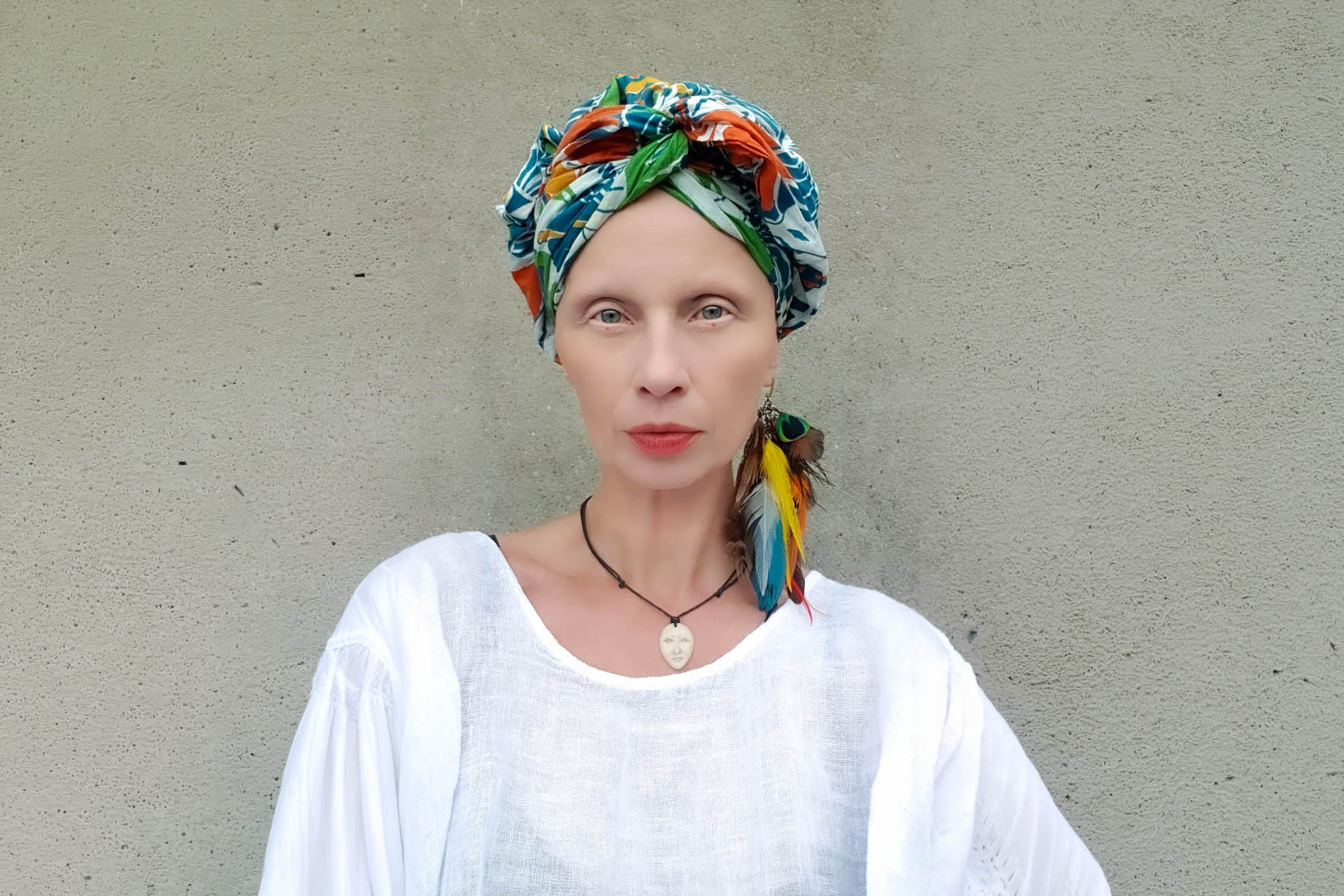
Why did I start sewing turbans?
For many years I have been living with alopecia – alopecia areata in its total form. In everyday life I wear hats, headscarves, wigs, and sometimes I simply go out with a bald head.
Each of these options has its advantages, but also its limitations.
Hats are soft, comfortable and practical. I like them a lot, but they don’t always suit me in terms of styling. A wig gives the look closest to a natural hairstyle, but it comes at a price: pressure, fixing bands and discomfort that can appear after many hours of wear.
So I was looking for something in between. Headwear as comfortable as a hat, but offering more ways to shape the silhouette and express femininity.
For years I experimented with headscarves, ways of tying them and different headwear constructions. Eventually I became interested in twist-off turbans.
I analysed how they were built and developed my own construction.
But it wasn’t only about covering my head. I wanted something that would be a fully fledged part of an outfit.
A hairstyle is also volume and form
Hair plays a huge role in how the head looks and in the proportions of the face. With a hairstyle we can add volume in certain places, visually lengthen or soften the shape of the face, and highlight its features.
When you lose your hair, you also lose the ability to shape your appearance this way.
That’s exactly why some of the headwear offered to women with hair-density issues didn’t appeal to me.
Many of them take the form of a soft, close-fitting cap. They are practical solutions, often designed with sensitive scalps in mind, but their aesthetics can be very limited.
A cap only covers the head. A turban with well-designed volume can also shape how it looks.
Draping, twists and folds of fabric make it possible to create different forms, much like a hairstyle.
This aspect was particularly important to me while designing.
You don’t have to lose your hair to love a turban
When I showed my idea to the women around me, something interesting happened.
It turned out that turbans also appealed to women with beautiful, healthy hair.
For them, a turban became a way to create an interesting look in no time.
Because there are days when there’s no time to style your hair. Or you simply don’t feel like it.
The popular phrase bad hair day sums up such moments perfectly.
A turban lets you change your look in a few moments, without having to prepare a complicated hairstyle. It can go with everyday clothes, but just as well become a bold accessory to an elegant dress.
It can simply complement your hairstyle, or protect your head from the sun or the cold.
And this greatly broadened my thinking about who I am actually designing turbans for.
Hair loss isn’t just about appearance
Hair loss can have many causes. One of them is cancer treatment, during which losing your hair can be a particularly difficult experience.
Psychological research shows that chemotherapy-induced hair loss can negatively affect body image, emotional well-being and social functioning.
For some patients, losing their hair is one of the most painful aspects of treatment. That doesn’t mean, however, that every woman experiences it in the same way.
Some choose wigs, others headscarves or turbans. And there are women who feel best with their head uncovered.
What matters most is that each of them has a real choice.
My turbans give women the chance to wear something that doesn’t look like a medical product. They leave room to play with fashion, colour and feminine styling.
Copper in turbans – from construction to symbolism
When designing my turbans, I decided to use copper wire to model their shape.
It’s a material I love not only for how well it can be shaped. Copper also has a long history of use in crafts, biology and symbolism.
It is a metal that has been part of human culture for thousands of years. It was used to make tools, vessels, jewellery and objects of ritual significance.
In the culture of the early medieval Slavs, amulets worn close to the body were believed to have protective functions. Some of them were made of copper and its alloys. This context is close to my heart. I like to think of copper as a material connected to our roots, and to the old custom of giving objects a meaning beyond their everyday function.
What does science know about copper?
Copper is an element essential for the human body. It is involved in the work of many enzymes, including those that take part in building connective tissue and protecting cells from oxidative stress.
It also has documented antimicrobial properties. Research has shown that on properly prepared copper surfaces, some microorganisms die much faster than on many other materials.
The question of copper’s contact with the skin is interesting too.
Studies have observed that metallic copper can oxidise under the influence of substances present on the surface of the skin, and the resulting compounds can penetrate its outer layers.
It is an element found in nature, a metal with a rich history and a distinctive malleability. To me, copper is the metal world’s equivalent of a natural fibre.
That’s why, when I can choose the material to shape a turban, I prefer copper to aluminium or some random alloy. It is my design and aesthetic choice.
The white turban in Kundalini yoga – a curiosity from another world
I discovered yet another meaning of headwear thanks to a conversation with my friend Ania Matuszkiewicz, who runs Strefa Bycia in Warsaw, where Kundalini yoga plays an important role.
In the Kundalini tradition associated with the teachings of Yogi Bhajan, white turbans can be part of meditative practice.
According to these teachings, wrapping the head in several layers of natural fabric helps focus attention, concentrate energy and direct intention towards the so-called third eye. White is associated with purity, clarity of mind and strengthening the aura.
It’s such an interesting subject that it deserves an article of its own. Especially since it shows how many meanings – practical, cultural and personal – can be hidden in a single piece of headwear.
So why would you need a turban?
There can be many reasons.
A turban can protect your head from the sun or the cold, help out on days when there’s no time for your hair, or be a striking part of your wardrobe.
It can also be part of a spiritual practice, a personal symbol, or simply a beautiful accessory that changes the character of the whole outfit.
It can also be a lifeline in a crisis, when it’s not only the body that suffers, but also your sense of femininity.
Not every woman needs it for the same reason.
My first turban came from a very specific need: I wanted to combine comfort with the chance to dress up.
Only later did it turn out that this solution could meet the needs of other women too.
And you? Would you put on a turban instead of styling your hair, or would you rather treat it as an accent for your favourite outfit?
Big hugs,
Peri XOXOXO
P.S. If you know a woman for whom such a turban would bring relief or a smile, please send her the link to this article.


